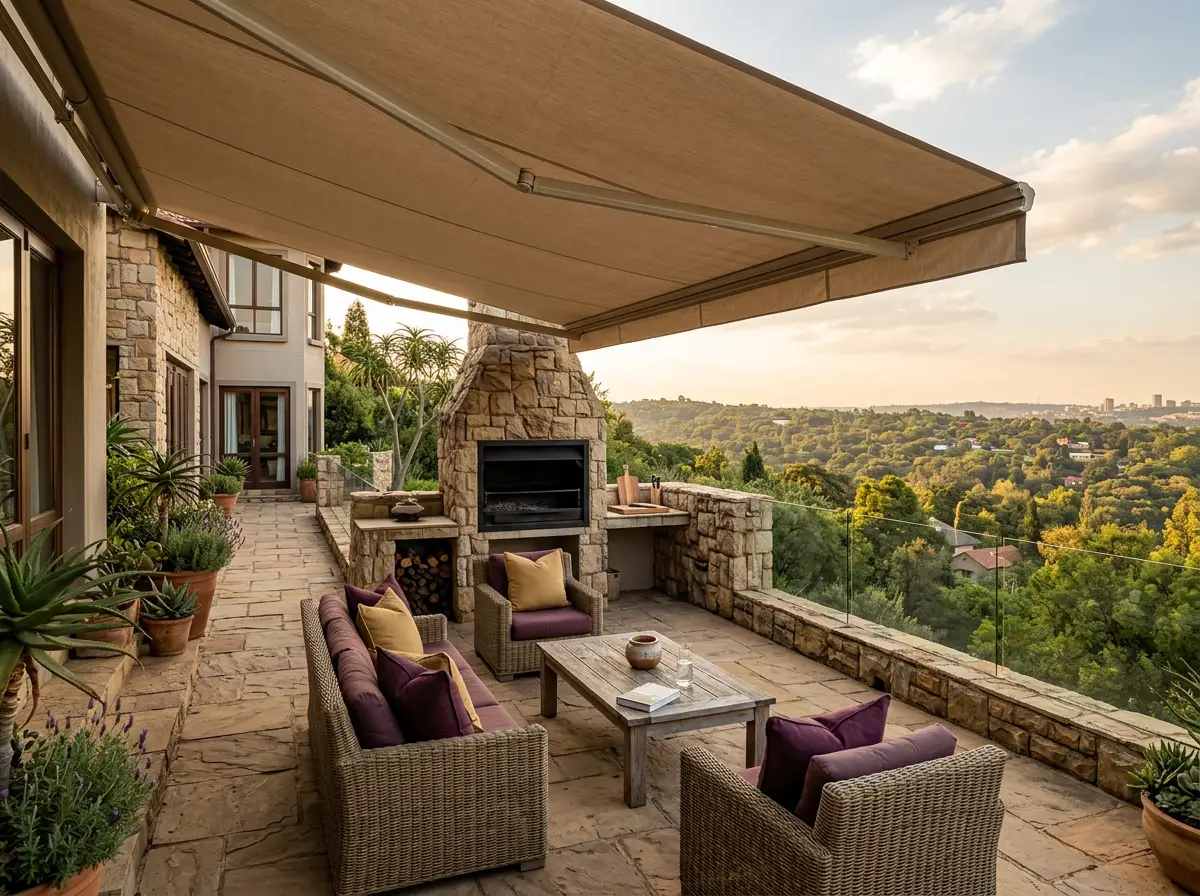
Shade the braai on demand.
Retractable patio awnings for ridge-top entertaining — motorised, wind-sensored, and gone completely when you don't need them.
Retractable patio awnings for ridge-top entertaining — motorised, wind-sensored, and gone completely when you don't need them.
The Outdoor Room
A folding-arm awning is a fabric canopy on spring-tensioned arms — no posts, no permanent roof — that disappears into a cassette against the wall when you don't need it.
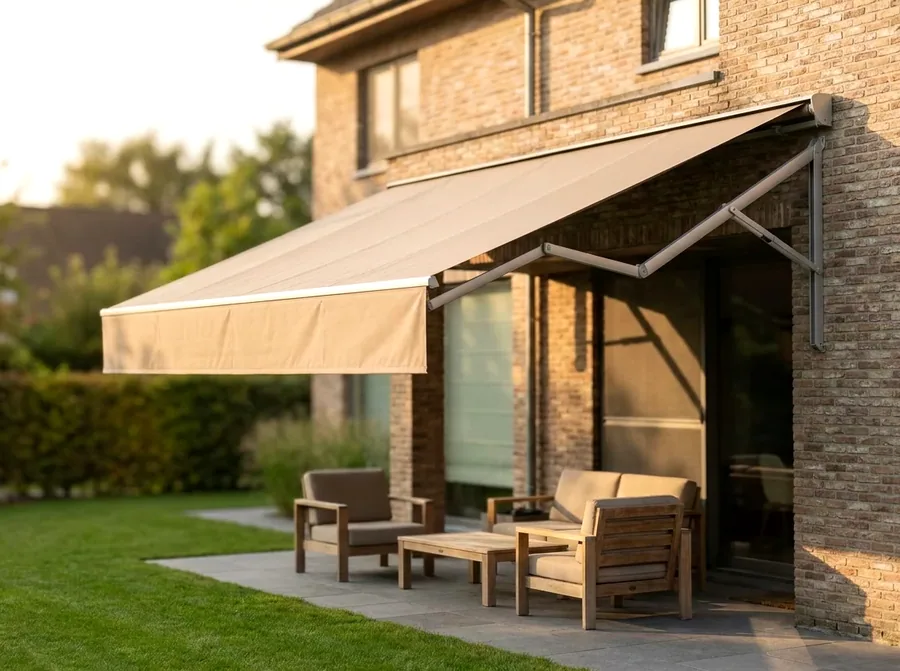
For a ridge-top patio built around a view, a fixed roof is the wrong answer twice over — it blocks the view permanently and it can't be removed for the months it isn't needed. A folding-arm awning turns a baking north or west patio back into a usable room in summer, then retracts to let welcome winter sun through, and because there are no support posts, there's nothing standing between the braai and the view either way.
Elevated ridge stands catch more wind than the streets below them, which is the first thing we plan for on a Bedfordview awning quote — not an afterthought. We spec motorised operation with an automatic wind sensor as standard on every exterior awning we fit here: it retracts on its own before gusts get to a level that could damage a fully extended canopy left unattended, which matters more up here than almost anywhere else in the metro. On stone-built patios with a fireplace or braai, we also plan the fixing points around the existing structure rather than around a generic bracket layout.
"An awning caught open in a highveld storm gust isn't unlucky — it's a wind sensor that wasn't specified."Why it's standard, not optional, up here
A full cassette (fabric and arms sealed away completely) is the right call for weather-exposed, ridge-facing positions; semi-cassette and open mounting suit more sheltered walls. Projection runs to roughly 3–4m over wide spans in solution-dyed acrylic fabrics that hold their colour under South African UV. Crank-handle operation exists, but motorised with a wind sensor is what we recommend on every install here. LED lighting and a vertical drop-valance are available as add-ons on premium lines, useful for evening entertaining once the sun's gone down but the view hasn't.
An awning is a shade product, not a rain product — it copes with light drizzle at a pitch, never storm rain or standing water. Wind ratings are real engineering limits, not suggestions, which is exactly why the sensor matters. And the fixing substrate matters: brick, timber and steel all take the mounting hardware differently, so a proper site assessment at the measure isn't optional.
With the wind sensor doing its job, yes — it retracts automatically ahead of damaging gusts. Manual, non-sensored awnings left extended in a storm are the ones that get damaged, which is why we don't recommend that setup on an exposed ridge stand.
Yes — awning overhead and zip screens on the open sides is a common combination for Bedfordview patios that get used year-round. We'll quote both together at the same measure.
Where We Fit These
What It Costs
The sum is width multiplied by projection, and the guide, installed, is R3,500 to R5,500 per square metre for a crank-handle awning and R5,500 to R7,500 per square metre for a motorised one with a wind sensor. A full cassette that closes the fabric away, and the deeper projections, both push a job towards the top of its band.
A short awning over a single door carries a minimum charge, because the arms, the cassette and the wall fixing are the same work at any width. Nothing is quoted from a photograph: the wall, the substrate, the exposure and the projection are all assessed at the free measure, and the written price follows that.
Ready When You Are
Book a free in-home measure — a consultant assesses the fixing points and quotes the full install in writing.
Book your free measure